

[Jan-2022] 1Z0-997-20 Exam Dumps - Free Demo & 365 Day Updates
Free Sales Ending Soon - Use Real 1Z0-997-20 PDF Questions
NEW QUESTION 63
You have deployed a multi-tier application with multiple compute instances in Oracle Cloud Infrastructure. You want to back up these volumes and have decided to use Volume Group's feature. The Block volume and Compute instances exist in different compartments within your tenancy.
Periodically. a few child compartments are moved under different parent compartments, and you notice that sometimes volume group backup fails.
What could be the cause?
- A. You have the same block volume attached to multiple compute instances; if these compute instances are in different compartments then all concerned compartments must be moved at the same time.
- B. Compute instance with multiple block volumes attached cannot move when a compartment is moved.
- C. The Identity and Access Management policy allowing backup failed to move when the compartment was moved.
- D. You are exceeding your volume group backup quota configured.
Answer: C
Explanation:
You can move a compartment to a different parent compartment within the same tenancy. When you move a compartment, all its contents (subcompartments and resources) are moved with it. Moving a compartment has implications for the contents.
After you move a compartment to a new parent compartment, the access policies of the new parent take effect and the policies of the previous parent no longer apply. Before you move a compartment, ensure that:
You are aware of the policies that govern access to the compartment in its current position.
You are aware of the polices in the new parent compartment that will take effect when you move the compartment.
In some cases, when moving nested compartments with policies that specify the hierarchy, the polices are automatically updated to ensure consistency.
NEW QUESTION 64
Give this compartment structure: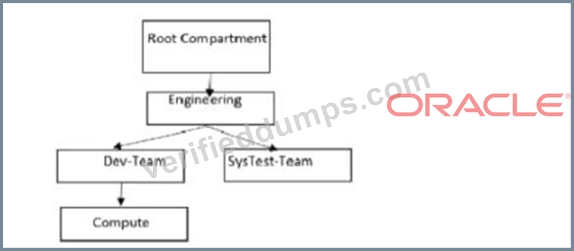
You want to move a compute instance that is in 'Compute' compartment to 'SysTes-Team'.
You login to your Oracle Cloud Infrastructure (OCI)account and use the 'Move Resource' option.
What will happen when you attempt moving the compute resource?
- A. The move will fail and you will be prompted to move the VCN first. Once VCN is moved to the target compartment, the Compute instance can be moved.
- B. The move will be successful though Compute Instance Public and Private IP address changed, and it will be associated to the VCN in target compartment.
- C. The move will be successful though Compute Instance and its Public and Private IP address will stay the same. The Compute instance VNIC will need to be moved separately. The Compute instance will still be associated with the original VCN.
- D. The move will be successful though Compute Instance and its Public and Private IP address will stay the same. The Compute instance VNIC will still be associated with the original VCN.
Answer: D
Explanation:
Moving Resources to a Different Compartment
Most resources can be moved after they are created. There are a few resources that you can't move from one compartment to another. Some resources have attached resource dependencies and some don't.
Not all attached dependencies behave the same way when the parent resource moves.
For some resources, the attached dependencies move with the parent resource to the new compartment.
The parent resource moves immediately, but in some cases attached dependencies move asynchronously and are not visible in the new compartment until the move is complete.
For other resources, the attached resource dependencies do not move to the new compartment. You can move these attached resources independently.
You can move Compute resources such as instances, instance pools, and custom images from one compartment to another. When you move a Compute resource to a new compartment, associated resources such as boot volumes and VNICs are not moved.
You can move a VCN from one compartment to another. When you move a VCN, its associated VNICs, private IPs, and ephemeral IPs move with it to the new compartment.
NEW QUESTION 65
Which of the below options for private access to services within Oracle Cloud Infrastructure (OCI) is NOT valid?
- A. The private endpoint gives hosts within your Virtual Cloud Network access to a given service within Oracle Cloud Infrastructure.
- B. You cannot use the private endpoint for hosts in the on-premises network.
- C. Traffic from an OCI compute instance going through a Service Gateway to Object Storage is routed without being sent over the internet.
- D. You can enable private access to certain services within OCI from your Virtual Cloud Network by using either a private endpoint or a service gateway.
Answer: B
NEW QUESTION 66
A company is running High Performance Computing workloads on Oracle Cloud Infrastructure and are using OCI bare metal compute shape. They have decided to create a custom image of the bare metal instance's boot disk and use it to launch other instances.
Which of the following is a NOT a true statement?
- A. Before you create a custom image of an instance, you must disconnect all iSCSI attachments and remove all iscsid node configurations from the instance.
- B. Custom images do not include the data from any attached block volumes.
- C. Editing custom Windows images is not supported due to hardware differences between shapes.
- D. You can create additional custom images of an instance while the instance is engaged in the image creation process.
Answer: D
NEW QUESTION 67
The Finance department of your company has reached out to you. They have customer sensitive data on compute Instances In Oracle Cloud Infrastructure (OCI) which they want to store in OCI Storage for long term retention and archival.
To meet security requirements they want to ensure this data is NOT transferred over public internet, even if encrypted.
which they want to store In OCI Object Storage fin long term retention and archival To meet security requirements they want to ensure this data is NOT transferred over public Internet, even it encrypted.
Which option meets this requirements?
- A. Use NAT gateway with appropriate route table when transferring data. Then use NAT gateways' toggle (on/off) once data transfer is complete.
- B. Use Storage gateway with appropriate firewall rule.
- C. Use Service gateway with appropriate route table.
- D. Configure a NAT instance and all traffic between compute In Private subnet should use this NAT instance with Private IP as the route target.
Answer: C
Explanation:
Explanation
Service Gateway is virtual router that you can add to your VCN. It provides a path for private network traffic between your VCN and supported services in the Oracle Services Network like Object Storage) so compute Instances in a private subnet in your VCN can back up data to Object Storage without needing public IP addresses or access to the intern
NEW QUESTION 68
You are responsible for migrating your on premises legacy databases on 11.2.0.4 version to Autonomous Transaction Processing Dedicated (ATP-D) In Oracle Cloud Infrastructure (OCI). As a solution architect, you need to plan your migration approach.
Which two options do you need to implement together to migrate your on premises databases to OCI?
- A. Retain all legacy structures and unsupported features (e.g. taw U>Bs) In the onuses databases for migration.
- B. Use Oracle Data Guard to keep on premises database always active during migration
- C. Use Oracle GoldenGate replication to keep on premises database online during migration.
- D. Convert on-premises databases to PDB, upgrade to 19c, and encrypt Migration.
- E. Retain changes to Oracle shipped privileges, stored procedures or views In the on-premises databases.
Answer: C,D
Explanation:
Explanation
Autonomous Database is an Oracle Managed and Secure environment.
A physical database can't simply be migrated to autonomous because:
- Database must be converted to PDB, upgraded to 19c, and encrypted
- Any changes to Oracle shipped privileges, stored procedures or views must be removed
- All legacy structures and unsupported features must be removed (e.g. legacy LOBs) GoldenGate replication can be used to keep database online during migration
NEW QUESTION 69
Your Oracle database is deployed on-premises and has produced 100 TB database backup locally. You have a disaster recovery plan that requires you to create redundant database backups in Oracle Cloud Infrastructure (OCI).
Once the initial backup is completed, the backup must be available for retrieval in less than 30 minutes to support the Recovery Time Objective (RTO) of your solution.
Which is the most cost effective option to meet these requirements?
- A. Setup a FastConnect connection between on-premises data center and OCI. Then to use OCI CLI command to upload database backups to OCI Object Storage Standard tier as the final destination.
- B. Use OCI Storage Gateway to transfer the backup files to OCI Object Storage Standard tier as the final destination.
- C. Setup an IPsec VPNConnect between on-premises data center and OCI. Then to use OCI CLI command to upload database backups to OCI Object Storage Archive tier as the final destination.
- D. Use OCI Storage Gateway to transfer the backup files to OCI Object Storage Archive tier as the final destination.
Answer: B
NEW QUESTION 70
You have been asked to review some network proposals by a major client. The client's IT director needs to provision two Virtual Cloud Network (VCN) for a major application. Both applications use a large number of virtual machine instances, and so will ideally occupy VCNs with as many address spaces as possible.
Additionally, in the future, VCN peering will be required to allow communication between the VCNs.
Which of the following are valid IP ranges to consider for the VCNs?
- A. 10.0.0.0/24 and 10.0.1.0/24
- B. 10.0.0.0/16 and 10.0.64.0/24
- C. 10.0.0.0/8 and 11.0.0.0/8
- D. 10.0.1.0/24 and 10.0.1.0/27
Answer: A
NEW QUESTION 71
You are creating an Oracle Cloud Infrastructure Dynamic Group. To determine the members of this group you are defining a set of matching rules.
Which of the following are the supported variables to define conditions in the matching rules? (Choose Two)
- A. instance.tenancy.id - the OCID of the tenancy where the instance resides.
- B. iam.policy.id - the OCID of the IAM policy to apply to the group.
- C. instance.compartment.id - the OCID of the compartment where the instance resides.
- D. tag.<tagnamespace>.<tagkey>.value - the tag namespace and tag key.
Answer: C,D
Explanation:
Explanation
You can define the members of the dynamic group based on the following:
- compartment ID
- instance ID
- tag namespace and tag key
- tag namespace, tag key, and tag value
Supported variables are:
instance.compartment.id - the OCID of the compartment where the instance resides instance.id - the OCID of the instance tag.<tagnamespace>.<tagkey>.value - the tag namespace and tag key. For example, tag.department.operations.value .
tag.<tagnamespace>.<tagkey>.value=' ' - the tag namespace, tag key, and tag value. For example, tag.department.operations.value='45'
NEW QUESTION 72
You are working as a solution architect for a customer in Frankfurt, which uses multiple compute instance VMs spread among three Availability Domains in the Oracle Cloud Infrastructure (OCI) eu-frankfurt-1 region.
The compute instances do not have public IP addresses and are running in private subnets inside a Virtual Cloud Network (VCN). You have set up OCI Autoscaling feature for the compute instances, but find out that instances cannot be auto scaled. You have enabled monitoring on the instances.
What could be wrong in this situation?
- A. You need to assign a reserved public IP address to the compute instances.
- B. You need to set up a Service Gateway to send metrics to the OCI Monitoring service.
- C. Autoscaling only works for instances with public IP addresses.
- D. Autoscaling only works with single availability domains.
Answer: B
NEW QUESTION 73
You work for a retail company and they developed a Microservices based shopping application that needs to access Oracle Autonomous Database from the application. As an Architect, you have been tasked to treat all of the application components as Kubernetes native objects, such as the microservices, Oracle Autonomous database, Kubernetes services, etc.
What should you do to make sure that you can use Kubernetes constructs to manage the life cycle of the application components, including Oracle Autonomous Database? (Choose the best answer.)
- A. Install and secure the OCI Service Broker for Kubernetes. Then provision and bind to the required Oracle Cloud Infrastructure services.
- B. Provision an Oracle Autonomous Database and then use OCI Service Broker to access the database as a native component to your Kubernetes cluster.
- C. Create a service from the Kubernetes cluster and point to the Oracle Autonomous Database using its FQDN.
- D. Create an Oracle Cloud Infrastructure (OCI) Service Gateway and connect to the Oracle Autonomous Database using the private IP address from the microservice.
Answer: A
Explanation:
OCI Service Broker for Kubernetes is an implementation of the Open Service Broker API. OCI Service Broker for Kubernetes is specifically for interacting with Oracle Cloud Infrastructure services from Kubernetes clusters. It includes three service broker adapters to bind to the following Oracle Cloud Infrastructure services: Object Storage Autonomous Transaction Processing Autonomous Data Warehouse
NEW QUESTION 74
You have multiple IAM users who launch different types of compute Instances and block volumes every day. As a result, your Oracle cloud Infrastructure (OCF) tenancy quickly hit the service limit and you can no longer create any new instances. As you are cleaning up environment, you notice that the majority of the Instances and block volumes are untagged. Therefore, It is difficult to pinpoint the owner of these resources verify if they are safe to terminate.
Because of this, your company has issued a new mandate, which requires adding compute instances.
Which option is the simplest way to implement this new requirement?
- A. Create a default tag for each compartment, which ensure that appropriate tags are applied at resource creation
- B. Create tag variables to automatically tag a resource with the user name.
- C. Create a policy to automatically tag a resource with the user name.
- D. Create a policy using IAM requiring users to tag specific resources. This will allow a user to launch compute instances on\y if certain tags were defined.
- E. Create tag variables for each compartment to automatically tag a resource with the user name.
Answer: B
Explanation:
Tag Variables
You can use a variable to set the value of a defined tag. When you add the tag to a resource, the variable resolves to the data it represents. You can use tag variables in defined tags and default tags.
Supported Tag Variables
The following tag variables are supported.
${iam.principal.name} The name of the principal that tagged the resource
${iam.principal.type} The type of principal that tagged the resource.
${oci.datetime} The date and time that the tag was created.
Consider the following example:
Operations.CostCenter=" ${iam.principal.name} at ${oci.datetime} "
Operations is the namespace, CostCenter is the tag key, and the tag value contains two tag variables ${iam.principal.name} and ${oci.datetime} . When you add this tag to a resource, the variable resolves to your user name (the name of the principal that applied the tag) and a time date stamp for when you added the tag.
user_name at 2019-06-18T18:00:57.604Z
The variable is replaced with data at the time you apply the tag. If you later edit the tag, the variable is gone and only the data remains. You can edit the tag value in all the ways you would edit any other tag value. To create a tag variable, you must use a specific format.
${<variable>} Type a dollar sign followed by open and close curly brackets. The tag variable goes between the curly brackets. You can use tag variables with other tag variables and with string values. Tag defaults let you specify tags to be applied automatically to all resources, at the time of creation, in a specific compartment. This feature allows you to ensure that appropriate tags are applied at resource creation without requiring the user who is creating the resource to have access to the tag namespaces.
https://docs.cloud.oracle.com/en-us/iaas/Content/Tagging/Tasks/managingtagdefaults.htm
NEW QUESTION 75
A retail company runs their online shopping platform entirely on Oracle cloud Infrastructure (OCI). This is a 3-tier web application that Includes a Mbps Load Balancer. Virtual Machine Instances for web and an Oracle DB Systems Virtual Machine Due to unprecedented growth, they noticed an Increase in the Incoming traffic to their website and all users start getting 503 (Service Unavailable) errors.
What is the potential problem in this scenario?
- A. The Load Balancer health check status Indicates critical situation for half of the backend webservers
- B. The Database Is down hence users can not access the web site
- C. The Traffic Management Policy is not set to load Balancer the traffic to the web servers.
- D. All the web servers are too busy and not able to answer any request from users.
- E. You did not configure a Service Gateway to allow connection between web servers and load Balance
Answer: D
Explanation:
A 503 Service Unavailable Error is an HTTP response status code indicating that a server is temporarily unable to handle the request. This may be due to the server being overloaded or down for maintenance.
NEW QUESTION 76
You are working as a solution architect for an online retail store to create a portal to allow the users to pay for their groceries using credit cards. Since the application is not fully compliant with the Payment Card Industry Data Security Standard (PCI DSS), your company is looking to use a third party payment service to process credit card payments.
The third party service allows a maximum of Spelunk IP addresses 5 public IP addresses at a time However, your website is using Oracle Cloud Infrastructure (OCI) Instance Pool Auto Scaling policy to create up to create up to 15 Instances during peak traffic demand, which are launched In VCN private in VCN private subnets and attached to an OCI public Load Balancer. Upon user payment, the portal connects to the payment service over the Interne! to complete the transaction What solution can you implement to make sure that all compute Instances can connect to the third party system to process the payments aw peak traffic demand?
- A. Create an OCI Command Line Interface (CLI) script to automatically reserve public IP address for the compute instances. On the third services, whitelist the Reserved public IP.
- B. Route payment request from the compute instances through the OCI Load Balancer, which will then be routed to the third party service.
- C. Route credit card payment request from the compute instances through the NAT Gateway. On the third-party services, whitest the public IP associated with the NAT Gateway.
- D. Whitelist the Internet Gateway Public IP on the third party service and route all payment requests through the Internet Gateway.
Answer: B
Explanation:
You can OCI Load Balancer for this solution which can you the Public IPs of Load balancer to Traffic to third party services which allows a maximum of Spelunk IP addresses 5 public IP addresses at a time However, your website is using Oracle Cloud Infrastructure (OCI) Instance Pool Auto Scaling policy to create up to 15 Instances during peak traffic demand
NEW QUESTION 77
A company has an urgent requirement to migrate 300 TB of data to Oracle Cloud Infrastructure (OCI) In two weeks. Their data center has been recently struck by a massive hurricane and the building has been badly damaged, although still operational. They have a 100 Mbps Internet line but the connection is Intermittent due to the damages caused to the electrical grid in this scenario, what is the most effective service to use to migrate the data to OCI given the time constraints?
- A. Upload the data to OCI using OCI Object Storage multipart upload tool.
- B. Setup a OCI Storage Gateway to connect your data center and your VCN. Once the connection has been established, upload all data to OCI using OCI Storage Gateway Cloud Sync tool.
- C. Setup a hybrid network by launching aIGbpsFastConnect virtual circuit between your data center and OCI. Use OCI Object storage multipart upload tool to automate the migration of your data to OCI.
- D. Use multiple OCI Data Transfer Appliances to transfer data to OCI.
- E. Storage Gateway to connect your data center and your VCN. Once the connection has been established, upload all data to OCI.
Answer: D
Explanation:
Due to the network speed is not good enough and the connection is Intermittent due to the damages caused to the electrical grid Oracle offers offline data transfer solutions that let you migrate data to Oracle Cloud Infrastructure.
You have 2 Options of Data Transfer
DISK-BASED DATA TRANSFER
You send your data as files on encrypted commodity disk to an Oracle transfer site. Operators at the Oracle transfer site upload the files into your designated Object Storage bucket in your tenancy.
APPLIANCE-BASED DATA TRANSFER
you send your data as files on secure, high-capacity, Oracle-supplied storage appliances to an Oracle transfer site. Operators at the Oracle transfer site upload the data into your designated Object Storage bucket in your tenancy.
NEW QUESTION 78
......
1Z0-997-20 Dumps - Pass Your Certification Exam: https://pass4sure.verifieddumps.com/1Z0-997-20-valid-exam-braindumps.html
