

Latest AZ-204 Practice Test Questions Verified Answers As Experienced in the Actual Test!
Pass Microsoft AZ-204 Exam in First Attempt Easily
NEW QUESTION # 163
You are developing an ASP.NET Core website that can be used to manage photographs which are stored in Azure Blob Storage containers.
Users of the website authenticate by using their Azure Active Directory (Azure AD) credentials.
You implement role-based access control (RBAC) role permission on the containers that store photographs.
You assign users to RBAC role.
You need to configure the website's Azure AD Application so that user's permissions can be used with the Azure Blob containers.
How should you configure the application? To answer, drag the appropriate setting to the correct location.
Each setting may be used once, more than once, or not at all. You may need to drag the split bar between panes or scroll to view content.
NOTE: Each correct selection is worth one point.
Answer:
Explanation:
Explanation
Box 1: user_impersonation
Box 2: delegated
Example:
1.Select the API permissions section
2.Click the Add a permission button and then:
Ensure that the My APIs tab is selected
3.In the list of APIs, select the API TodoListService-aspnetcore.
4.In the Delegated permissions section, ensure that the right permissions are checked: user_impersonation.
5.Select the Add permissions button.
Box 3: delegated
Example
1.Select the API permissions section
2.Click the Add a permission button and then,
Ensure that the Microsoft APIs tab is selected
3.In the Commonly used Microsoft APIs section, click on Microsoft Graph
4.In the Delegated permissions section, ensure that the right permissions are checked: User.Read. Use the search box if necessary.
5.Select the Add permissions button
References:
https://docs.microsoft.com/en-us/samples/azure-samples/active-directory-dotnet-webapp-webapi-openidconnect-
NEW QUESTION # 164
You are developing a .NET Core MVC application for customers to research hotels. The application will use Azure Search. The application will search the index by using various criteria to locate documents related to hotels. The index will include search fields for rate, a list of amenities, and distance to the nearest airport.
The application must support the following scenarios for specifying search criteria and organizing results:
* Search the index by using regular expressions.
* Organize results by counts for name-value pairs.
* List hotels within a specified distance to an airport and that fall within a specific price range.
You need to configure the SearchParameters class.
Which properties should you configure? To answer, select the appropriate options in the answer area.
NOTE Each correct selection is worth one point.
Answer:
Explanation:
Explanation
Box 1: QueryType
The SearchParameters.QueryType Property gets or sets a value that specifies the syntax of the search query.
The default is 'simple'. Use 'full' if your query uses the Lucene query syntax.
You can write queries against Azure Search based on the rich Lucene Query Parser syntax for specialized query forms: wildcard, fuzzy search, proximity search, regular expressions are a few examples.
Box 2: Facets
The facets property gets or sets the list of facet expressions to apply to the search query. Each facet expression contains a field name, optionally followed by a comma-separated list of name:value pairs.
Box 3: Filter
The Filter property gets or sets the OData $filter expression to apply to the search query.
References:
https://docs.microsoft.com/en-us/dotnet/api/microsoft.azure.search.models.searchparameters
https://docs.microsoft.com/en-us/azure/search/query-lucene-syntax
https://docs.microsoft.com/en-us/dotnet/api/microsoft.azure.search.models.searchparameters.querytype
NEW QUESTION # 165
You are developing a solution for a hospital to support the following use cases:
*The most recent patient status details must be retrieved even if multiple users in different locations have updated the patient record.
*Patient health monitoring data retrieved must be the current version or the prior version.
*After a patient is discharged and all charges have been assessed, the patient billing record contains the final charges.
You provision a Cosmos DB NoSQL database and set the default consistency level for the database account to Strong. You set the value for Indexing Mode to Consistent.
You need to minimize latency and any impact to the availability of the solution. You must override the default consistency level at the query level to meet the required consistency guarantees for the scenarios.
Which consistency levels should you implement? To answer, drag the appropriate consistency levels to the correct requirements. Each consistency level may be used once, more than once, or not at all. You may need to drag the split bar between panes or scroll to view content.
NOTE: Each correct selection is worth one point.
Answer:
Explanation:
Explanation
Box 1: Strong
Strong: Strong consistency offers a linearizability guarantee. The reads are guaranteed to return the most recent committed version of an item. A client never sees an uncommitted or partial write. Users are always guaranteed to read the latest committed write.
Box 2: Bounded staleness
Bounded staleness: The reads are guaranteed to honor the consistent-prefix guarantee. The reads might lag behind writes by at most "K" versions (that is "updates") of an item or by "t" time interval. When you choose bounded staleness, the "staleness" can be configured in two ways:
The number of versions (K) of the item
The time interval (t) by which the reads might lag behind the writes
Box 3: Eventual
Eventual: There's no ordering guarantee for reads. In the absence of any further writes, the replicas eventually converge.
NEW QUESTION # 166
You are developing an application that needs access to an Azure virtual machine (VM). The access lifecycle for the application must be associated with the VM service instance. You need to enable managed identity for the VM.
How should you complete the PowerShell segment? To answer, select the appropriate options in the answer area.
NOTE Each correct selection is worth one point.
Answer:
Explanation:
Explanation
$vm = Get-AzVM -ResourceGroupName myResourceGroup -Name myVM
Update-AzVM -ResourceGroupName myResourceGroup -VM $vm -AssignIdentity:$SystemAssigned
https://docs.microsoft.com/en-us/azure/active-directory/managed-identities-azure-resources/qs-configure-powers
NEW QUESTION # 167
You
are developing an Azure App Service hosted ASP.NET Core web app to deliver video on-demand streaming media. You enable an Azure Content Delivery Network (CDN) Standard for the web endpoint. Customer videos are downloaded from the web app by using the following example URL.:
http://www.contoso.com/content.mp4?quality=1
All media content must expire from the cache after one hour. Customer videos with varying quality must be delivered to the closest regional point of presence (POP) node.
You need to configure Azure CDN caching rules.
Which options should you use? To answer, select the appropriate options in the answer area.
NOTE: Each correct selection is worth one point.
Answer:
Explanation:
Explanation
Box 1: Override
Override: Ignore origin-provided cache duration; use the provided cache duration instead. This will not override cache-control: no-cache.
Set if missing: Honor origin-provided cache-directive headers, if they exist; otherwise, use the provided cache duration.
Incorrect:
Bypass cache: Do not cache and ignore origin-provided cache-directive headers.
Box 2: 1 hour
All media content must expire from the cache after one hour.
Box 3: Cache every unique URL
Cache every unique URL: In this mode, each request with a unique URL, including the query string, is treated as a unique asset with its own cache. For example, the response from the origin server for a request for example.ashx?q=test1 is cached at the POP node and returned for subsequent caches with the same query string. A request for example.ashx?q=test2 is cached as a separate asset with its own time-to-live setting.
Reference:
https://docs.microsoft.com/en-us/azure/cdn/cdn-query-string
NEW QUESTION # 168
You are developing a back-end Azure App Service that scales based on the number of messages contained in a Service Bus queue.
A rule already exists to scale up the App Service when the average queue length of unprocessed and valid queue messages is greater than 1000.
You need to add a new rule that will continuously scale down the App Service as long as the scale up condition is not met.
How should you configure the Scale rule? To answer, select the appropriate options in the answer area.
NOTE: Each correct selection is worth one point.
Answer:
Explanation:
NEW QUESTION # 169
A company runs an international travel and bookings management service. The company plans to begin offering restaurant bookings. You must develop a solution that uses Azure Search and meets the following requirements:
* Users must be able to search for restaurants by name, description, location, and cuisine.
* Users must be able to narrow the results further by location, cuisine, rating, and family-friendliness.
* All words in descriptions must be included in searches.
You need to add annotations to the restaurant class.
How should you complete the code segment? To answer, select the appropriate options in the answer area.
NOTE: Each correct selection is worth one point.
Answer:
Explanation:
Explanation

Box 1: [IsSearchable.IsFilterable.IsSortable,IsFacetable]
Location
Users must be able to search for restaurants by name, description, location, and cuisine.
Users must be able to narrow the results further by location, cuisine, rating, and family-friendliness.
Box 2: [IsSearchable.IsFilterable.IsSortable,Required]
Description
Users must be able to search for restaurants by name, description, location, and cuisine.
All words in descriptions must be included in searches.
Box 3: [IsFilterable,IsSortable,IsFaceTable]
Rating
Users must be able to narrow the results further by location, cuisine, rating, and family-friendliness.
Box 4: [IsSearchable.IsFilterable,IsFacetable]
Cuisines
Users must be able to search for restaurants by name, description, location, and cuisine.
Users must be able to narrow the results further by location, cuisine, rating, and family-friendliness.
Box 5: [IsFilterable,IsFacetable]
FamilyFriendly
Users must be able to narrow the results further by location, cuisine, rating, and family-friendliness.
References:
https://www.henkboelman.com/azure-search-the-basics/
NEW QUESTION # 170
You develop an app that allows users to upload photos and videos to Azure storage. The app uses a storage REST API call to upload the media to a blob storage account named Account1. You have blob storage containers named Container1 and Container2.
Uploading of videos occurs on an irregular basis.
You need to copy specific blobs from Container1 to Container2 when a new video is uploaded.
What should you do?
- A. Create an Event Grid topic that uses the Start-AzureStorageBlobCopy cmdlet
- B. Copy blobs to Container2 by using the Put Blob operation of the Blob Service REST API
- C. Download the blob to a virtual machine and then upload the blob to Container2
- D. Use AzCopy with the Snapshot switch to copy blobs to Container2
Answer: A
Explanation:
The Start-AzureStorageBlobCopy cmdlet starts to copy a blob.
Example 1: Copy a named blob
C:\PS>Start-AzureStorageBlobCopy -SrcBlob "ContosoPlanning2015" -DestContainer "ContosoArchives" -SrcContainer "ContosoUploads" This command starts the copy operation of the blob named ContosoPlanning2015 from the container named ContosoUploads to the container named ContosoArchives.
Reference:
https://docs.microsoft.com/en-us/powershell/module/azure.storage/start-azurestorageblobcopy?view=azurermps-6.13.0
NEW QUESTION # 171
Drag and Drop Question
You manage several existing Logic Apps.
You need to change definitions, add new logic, and optimize these apps on a regular basis.
What should you use? To answer, drag the appropriate tools to the correct functionalities. Each tool may be used once, more than once, or not at all. You may need to drag the split bar between panes or scroll to view content.
NOTE: Each correct selection is worth one point.
Answer:
Explanation:
Explanation:
Box 1: Enterprise Integration Pack
For business-to-business (B2B) solutions and seamless communication between organizations, you can build automated scalable enterprise integration workflows by using the Enterprise Integration Pack (EIP) with Azure Logic Apps.
Box 2: Code View Editor
Edit JSON - Azure portal
1. Sign in to the Azure portal.
2. From the left menu, choose All services. In the search box, find "logic apps", and then from the results, select your logic app.
3. On your logic app's menu, under Development Tools, select Logic App Code View.
4. The Code View editor opens and shows your logic app definition in JSON format.
Box 3: Logic Apps Designer
Reference:
https://docs.microsoft.com/en-us/azure/logic-apps/logic-apps-enterprise-integration-overview
https://docs.microsoft.com/en-us/azure/logic-apps/logic-apps-author-definitions
NEW QUESTION # 172
You are developing an application that use an Azure blob named data to store application data. The application creates blob snapshots to allow application state to be reverted to an earlier state. The Azure storage account has soft deleted enabled.
The system performs the following operations in order:
*The blob is updated
*Snapshot 1 is created.
*Snapshot 2 is created.
*Snapshot 1 is deleted.
A system error then deletes the data blob and all snapshots.
You need to determine which application states can be restored.
What is the restorability of the application data? To answer, select the appropriate options in the answer area.
NOTE: Each correct selection is worth one point.
Answer:
Explanation: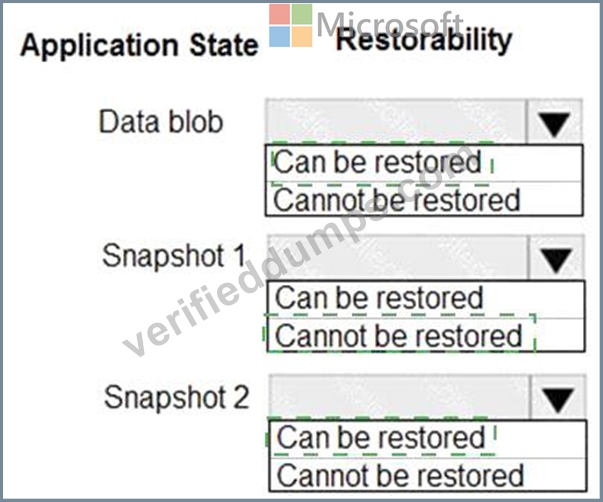
Explanation
Box 1: Can be restored
When enabled, soft delete enables you to save and recover your data when blobs or blob snapshots are deleted.
This protection extends to blob data that is erased as the result of an overwrite.
Box 2: Cannot be restored
It has been deleted.
Box 3: Can be restored
It has not been deleted.
References:
https://docs.microsoft.com/en-us/azure/storage/blobs/storage-blob-soft-delete
NEW QUESTION # 173
Case Study 3 - Proseware, Inc
Background
You are a developer for Proseware, Inc. You are developing an application that applies a set of governance policies for Proseware's internal services, external services, and applications. The application will also provide a shared library for common functionality.
Requirements
Policy service
You develop and deploy a stateful ASP.NET Core 2.1 web application named Policy service to an Azure App Service Web App. The application reacts to events from Azure Event Grid and performs policy actions based on those events.
The application must include the Event Grid Event ID field in all Application Insights telemetry.
Policy service must use Application Insights to automatically scale with the number of policy actions that it is performing.
Policies
Log Policy
All Azure App Service Web Apps must write logs to Azure Blob storage. All log files should be saved to a container named logdrop. Logs must remain in the container for 15 days.
Authentication events
Authentication events are used to monitor users signing in and signing out. All authentication events must be processed by Policy service. Sign outs must be processed as quickly as possible.
PolicyLib
You have a shared library named PolicyLib that contains functionality common to all ASP.NET Core web services and applications. The PolicyLib library must:
* Exclude non-user actions from Application Insights telemetry.
* Provide methods that allow a web service to scale itself
* Ensure that scaling actions do not disrupt application usage
Other
Anomaly detection service
You have an anomaly detection service that analyzes log information for anomalies. It is implemented as an Azure Machine Learning model. The model is deployed as a web service.
If an anomaly is detected, an Azure Function that emails administrators is called by using an HTTP WebHook.
Health monitoring
All web applications and services have health monitoring at the /health service endpoint.
Policy loss
When you deploy Policy service, policies may not be applied if they were in the process of being applied during the deployment.
Performance issue
When under heavy load, the anomaly detection service undergoes slowdowns and rejects connections.
Notification latency
Users report that anomaly detection emails can sometimes arrive several minutes after an anomaly is detected.
Relevant portions of the app files are shown below. Line numbers are included for reference only and include a two-character prefix that denotes the specific file to which they belong.

Relevant portions of the app files are shown below. Line numbers are included for reference only and include a two-character prefix that denotes the specific file to which they belong.
Drag and Drop Question
You need to implement the Log policy.
How should you complete the Azure Event Grid subscription? To answer, drag the appropriate JSON segments to the correct locations. Each JSON segment may be used once, more than once, or not at all. You may need to drag the split bar between panes or scroll to view content.
NOTE: Each correct selection is worth one point.
Answer:
Explanation:
Explanation:
Box 1:WebHook
Scenario: If an anomaly is detected, an Azure Function that emails administrators is called by using an HTTP WebHook.
endpointType: The type of endpoint for the subscription (webhook/HTTP, Event Hub, or queue).
Box 2: SubjectBeginsWith
Box 3: Microsoft.Storage.BlobCreated
Scenario: Log Policy
All Azure App Service Web Apps must write logs to Azure Blob storage. All log files should be saved to a container named logdrop. Logs must remain in the container for 15 days.
Example subscription schema
{
"properties": {
"destination": {
"endpointType": "webhook",
"properties": {
"endpointUrl":
"https://example.azurewebsites.net/api/HttpTriggerCSharp1?code=VXbGWce53l48Mt8wuotr0GP myJ/nDT4hgdFj9DpBiRt38qqnnm5OFg==" }
},
"filter": {
"includedEventTypes": [ "Microsoft.Storage.BlobCreated", "Microsoft.Storage.BlobDeleted" ],
"subjectBeginsWith": "blobServices/default/containers/mycontainer/log",
"subjectEndsWith": ".jpg",
"isSubjectCaseSensitive ": "true"
}
}
}
References:
https://docs.microsoft.com/en-us/azure/event-grid/subscription-creation-schema
NEW QUESTION # 174
You are developing a web application that will use Azure Storage. Older data will be less frequently used than more recent data.
You need to configure data storage for the application. You have the following requirements:
* Retain copies of data for five years.
* Minimize costs associated with storing data that is over one year old.
* Implement Zone Redundant Storage for application data.
What should you do? To answer, select the appropriate options in the answer area.
NOTE: Each correct selection is worth one point.
Answer:
Explanation:
Text Description automatically generated with medium confidence
Reference:
https://docs.microsoft.com/en-us/azure/storage/blobs/storage-blob-storage-tiers
https://docs.microsoft.com/en-us/azure/storage/common/storage-redundancy?toc=/azure/storage/blobs/toc.json
NEW QUESTION # 175
A company is developing a solution that allows smart refrigerators to send temperature information to a central location. You have an existing Service Bus.
The solution must receive and store messages until they can be processed. You create an Azure Service Bus instance by providing a name, pricing tier, subscription, resource group, and location.
You need to complete the configuration.
Which Azure CLI or PowerShell command should you run?
- A. Option A
- B. Option B
- C. Option D
- D. Option C
Answer: B
Explanation:
A service bus instance has already been created (Step 2 below). Next is step 3, Create a Service Bus queue.
Note:
Steps:
Step 1: # Create a resource group
resourceGroupName="myResourceGroup"
az group create --name $resourceGroupName --location eastus
Step 2: # Create a Service Bus messaging namespace with a unique name
namespaceName=myNameSpace$RANDOM
az servicebus namespace create --resource-group $resourceGroupName --name $namespaceName --location eastus
Step 3: # Create a Service Bus queue
az servicebus queue create --resource-group $resourceGroupName --namespace-name $namespaceName --name BasicQueue
Step 4: # Get the connection string for the namespace
connectionString=$(az servicebus namespace authorization-rule keys list --resource-group $resourceGroupName --namespace-name $namespaceName --name RootManageSharedAccessKey --query primaryConnectionString --output tsv)
Reference:
https://docs.microsoft.com/en-us/azure/service-bus-messaging/service-bus-quickstart-cli
NEW QUESTION # 176
You need to add code at line PC32 in Processing.cs to implement the GetCredentials method in the Processing class.
How should you complete the code? To answer, drag the appropriate code segments to the correct locations.
Each code segment may be used once, more than once, or not at all. You may need to drag the split bar between panes or scroll to view content.
NOTE: Each correct selection is worth one point.
Answer:
Explanation:
Explanation
Box 1: AzureServiceTokenProvider()
Box 2: tp.GetAccessTokenAsync("..")
Acquiring an access token is then quite easy. Example code:
private async Task<string> GetAccessTokenAsync()
{
var tokenProvider = new AzureServiceTokenProvider();
return await tokenProvider.GetAccessTokenAsync("https://storage.azure.com/");
}
Reference:
https://joonasw.net/view/azure-ad-authentication-with-azure-storage-and-managed-service-identity
NEW QUESTION # 177
You have a single page application (SPA) web application that manages information based on data returned by Microsoft Graph from another company's Azure Active Directory (Azure AD) instance.
Users must be able to authenticate and access Microsoft Graph by using their own company's Azure AD instance.
You need to configure the application manifest for the app registration.
How should you complete the manifest? To answer, select the appropriate options in the answer area.
NOTE: Each correct selection is worth one point.
Answer:
Explanation:
NEW QUESTION # 178
You are developing an application. You have an Azure user account that has access to two subscriptions.
You need to retrieve a storage account key secret from Azure Key Vault.
In which order should you arrange the PowerShell commands to develop the solution? To answer, move all commands from the list of commands to the answer area and arrange them in the correct order.
Answer:
Explanation:
Explanation
Step 1: Get-AzSubscription
If you have multiple subscriptions, you might have to specify the one that was used to create your key vault.
Enter the following to see the subscriptions for your account:
Get-AzSubscription
Step 2: Set-AzContext -SubscriptionId
To specify the subscription that's associated with the key vault you'll be logging, enter:
Set-AzContext -SubscriptionId <subscriptionID>
Step 3: Get-AzStorageAccountKey
You must get that storage account key.
Step 4: $secretvalue = ConvertTo-SecureString <storageAccountKey> -AsPlainText -Force Set-AzKeyVaultSecret -VaultName <vaultName> -Name <secretName> -SecretValue $secretvalue After retrieving your secret (in this case, your storage account key), you must convert that key to a secure string, and then create a secret with that value in your key vault.
Step 5: Get-AzKeyVaultSecret
Next, get the URI for the secret you created. You'll need this URI in a later step to call the key vault and retrieve your secret. Run the following PowerShell command and make note of the ID value, which is the secret's URI:
Get-AzKeyVaultSecret -VaultName <vaultName>
Reference:
https://docs.microsoft.com/bs-latn-ba/Azure/key-vault/key-vault-key-rotation-log-monitoring
NEW QUESTION # 179
You are developing a .NET Core MVC application for customers to research hotels. The application will use Azure Search. The application will search the index by using various criteria to locate documents related to hotels. The index will include search fields for rate, a list of amenities, and distance to the nearest airport.
The application must support the following scenarios for specifying search criteria and organizing results:
* Search the index by using regular expressions.
* Organize results by counts for name-value pairs.
* List hotels within a specified distance to an airport and that fall within a specific price range.
You need to configure the SearchParameters class.
Which properties should you configure? To answer, select the appropriate options in the answer area.
NOTE Each correct selection is worth one point.
Answer:
Explanation:
Explanation
Box 1: QueryType
The SearchParameters.QueryType Property gets or sets a value that specifies the syntax of the search query.
The default is 'simple'. Use 'full' if your query uses the Lucene query syntax.
You can write queries against Azure Search based on the rich Lucene Query Parser syntax for specialized query forms: wildcard, fuzzy search, proximity search, regular expressions are a few examples.
Box 2: Facets
The facets property gets or sets the list of facet expressions to apply to the search query. Each facet expression contains a field name, optionally followed by a comma-separated list of name:value pairs.
Box 3: Filter
The Filter property gets or sets the OData $filter expression to apply to the search query.
References:
https://docs.microsoft.com/en-us/dotnet/api/microsoft.azure.search.models.searchparameters
https://docs.microsoft.com/en-us/azure/search/query-lucene-syntax
https://docs.microsoft.com/en-us/dotnet/api/microsoft.azure.search.models.searchparameters.querytype
NEW QUESTION # 180
You plan to deploy a web app to App Service on Linux. You create an App Service plan. You create and push a custom Docker image that image that contains the web app to Azure Container Registry.
You need to access the console logs generated from inside the container in real-time.
How should you complete the Azure CLI command? To answer, select the appropriate options in the answer area.
NOTE: Each correct selection is worth one point.
Answer:
Explanation:
Reference:
https://docs.microsoft.com/en-us/cli/azure/webapp/log
NEW QUESTION # 181
You are developing a ticket reservation system for an airline.
The storage solution for the application must meet the following requirements:
Ensure at least 99.99% availability and provide low latency.
Accept reservations event when localized network outages or other unforeseen failures occur.
Process reservations in the exact sequence as reservations are submitted to minimize overbooking or selling the same seat to multiple travelers.
Allow simultaneous and out-of-order reservations with a maximum five-second tolerance window.
You provision a resource group named airlineResourceGroup in the Azure South-Central US region.
You need to provision a SQL SPI Cosmos DB account to support the app.
How should you complete the Azure CLI commands? To answer, select the appropriate options in the answer area.
NOTE: Each correct selection is worth one point.
Answer:
Explanation:
NEW QUESTION # 182
You are developing a solution to store documents in Azure Blob storage. Customers upload documents to multiple containers. Documents consist of PDF, CSV, Microsoft Office format, and plain text files.
The solution must process millions of documents across hundreds of containers. The solution must meet the following requirements:
* Document must the categorized by a customer identifier as they are uploaded to the storage account.
* Allow filtering by the customer identifier.
* Allow searching of information contained within a document.
* Minimize costs.
You created and configure a standard general-purpose v2 storage account to support the solution.
You need to implement the solution.
NOTE: Each correct selection is worth one point.
Answer:
Explanation:
NEW QUESTION # 183
You are working for Contoso, Ltd.
You define an API Policy object by using the following XML markup:
For each of the following statements, select Yes if the statement is true. Otherwise, select No.
NOTE: Each correct selection is worth one point.
Answer:
Explanation:
Explanation
Box 1: Yes
Use the set-backend-service policy to redirect an incoming request to a different backend than the one specified in the API settings for that operation. Syntax: <set-backend-service base-url="base URL of the backend service" /> Box 2: No The condition is on 512k, not on 256k.
Box 3: No
The set-backend-service policy changes the backend service base URL of the incoming request to the one specified in the policy.
Reference:
https://docs.microsoft.com/en-us/azure/api-management/api-management-transformation-policies
NEW QUESTION # 184
You need to update the APIs to resolve the testing error.
How should you complete the Azure CLI command? To answer, select the appropriate options in the answer area.
NOTE: Each correct selection is worth one point.
Answer:
Explanation:
Reference:
http://donovanbrown.com/post/How-to-clear-No-Access-Control-Allow-Origin-header-error-with-Azure-App-Service
NEW QUESTION # 185
You need to configure Azure CDN for the Shipping web site.
Which configuration options should you use? To answer, select the appropriate options in the answer area.
NOTE: Each correct selection is worth one point.
Answer:
Explanation:
Reference:
https://docs.microsoft.com/en-us/azure/cdn/cdn-optimization-overview
NEW QUESTION # 186
You are developing an ASP.NET Core time sheet application that runs as an Azure Web App. Users of the application enter their time sheet information on the first day of every month.
The application uses a third-party web service to validate data.
The application encounters periodic server errors due to errors that result from calling a third-party web server.
Each request to the third-party server has the same chance of failure.
You need to configure an Azure Monitor alert to detect server errors unrelated to the third-party service. You must minimize false-positive alerts.
How should you complete the Azure Resource Manager template? To answer, select the appropriate options in the answer area.
NOTE: Each correct selection is worth one point.
Answer:
Explanation:
Explanation
Graphical user interface Description automatically generated
Box 1: DynamicThresholdCriterion
Box 2: Http5xx
Server errors are in the 5xx range.
Client errors are in the 4xx range
Box 3: Low
Reference:
https://docs.microsoft.com/en-us/azure/azure-monitor/alerts/alerts-dynamic-thresholds
NEW QUESTION # 187
You are developing a ticket reservation system for an airline.
The storage solution for the application must meet the following requirements:
Ensure at least 99.99% availability and provide low latency.
Accept reservations event when localized network outages or other unforeseen failures occur.
Process reservations in the exact sequence as reservations are submitted to minimize overbooking or selling the same seat to multiple travelers.
Allow simultaneous and out-of-order reservations with a maximum five-second tolerance window.
You provision a resource group named airlineResourceGroup in the Azure South-Central US region.
You need to provision a SQL SPI Cosmos DB account to support the app.
How should you complete the Azure CLI commands? To answer, select the appropriate options in the answer area.
NOTE: Each correct selection is worth one point.
Answer:
Explanation:
NEW QUESTION # 188
......
We offers you the latest free online AZ-204 dumps to practice: https://pass4sure.verifieddumps.com/AZ-204-valid-exam-braindumps.html
